

Welcome to ONCOURSETurf! This blog is about anything and everything involved with Golf Course Management. It is the personal blog of Kevin J. Ross, CGCS - retired superintendent, Country Club of the Rockies - Vail, Colorado - Agronomic Services, ONCOURSETurf - Host of ON COURSE - TurfNetTV - General Turfgrass Management and Golf Nut. Follow Along and Enjoy! Twitter @oncourseturf
Showing posts with label vole control. Show all posts
Showing posts with label vole control. Show all posts
Tuesday, April 14, 2020
TurfNet TV - Latest Video is Live...
In my latest ONCOURSETurf video production for TurfNet.com I discuss a vole damage recovery technique I used while I was a superintendent in the high mountains of Colorado. This technique is different than normal thinking, but it works exceptionally well. Take a look HERE As always, thanks to my supporting sponsor www.tantoirrigation.com and thanks for watching!


Wednesday, August 7, 2019
Sweet Heart Winery Project.....
I was extremely excited when the owner of Sweetheart Winery in Loveland, Colorado, first contacted me concerning some agronomic consulting of the property. Having been to the winery on a few occasions, I really loved their grounds. I always looked at the lawn areas thinking they could be something really special with the correct agronomic program.
After a meeting and walk-around with the owner, I was hired to do the exact thing I had thought about - come up with an agronomic plan for the property! So, I went to work on the perfect plan. When you work as an agronomic consultant, there aren’t many times when someone tells you to do whatever it takes to get turf areas where they need to be. Starting with a blank canvas is always a good way to start.
The winery sits on the Big Thompson River and is a very environmentally sensitive area. In 2013, the river flooded and caused some major issues. The river restoration was just completing in the area at the time of my involvement with the property. Knowing the entire situation, the owner requested the use of an organic fertilizer source. It didn’t take me long to realize that one of my favorite fertilizers, Milorganite, would be my choice for this project. Milorganite is a natural slow-release fertilizer that I had used for some 35 years during my career as a golf course superintendent, and always was the mainstay of my nutritional program. Being a natural slow-release, Milorganite would offer the characteristics we would need. With the Big Thompson River flowing along the property, we wanted to protect the water quality and have no leaching of nutrients into the water. With the nitrogen in Milorganite, I knew there would be no leaching. We also wanted to build the soil structure and I knew that with the nitrogen from Milorganite, soil microorganisms would start to proliferate during the breakdown of the nitrogen. This would help build soil health quickly. With the winery only being open for two years, with minimal professional turf management, building long-term soil health was a goal of mine for the property. The iron in Milorganite would also be a big plus, as we could get some instant greening of the turf. Even though the use of Milorganite would be the mainstay of the overall fertility plan, there were other items to address as well.
 |
| The Winery is located on the Big Thompson River. |

Although the property was not that old, the irrigation system certainly needed to have an audit performed. No matter what the nutritional plan was, if the irrigation coverage wasn’t good, the turf health would be the same. So, I performed a complete audit of the system. This audit identified many fix-its which would make the system perform more efficiently. Items such as crooked heads, broken/clogged nozzles, minor leaks, and programming were all evaluated and fixed. Once the irrigation was working well, I new we were ready to get the turf in great shape.
With the turf condition very thin and weak, I decided to also include a small amount of urea (0.25#/N/M) as a jump-start for the turf. I also incorporated some humic acid as part of the nutrient program. I have now termed the program “The Hybrid Method” which means a small amount of synthetic plus a larger fraction of organic.
There was one more item to address at the winery and that was watering. The owner had asked me to do whatever we could to save on the water bill. Domestic water in Colorado is very expensive, so anything would be helpful. Colorado also experiences some very consistent dry weather with very low relative humidity. It’s not uncommon to have ET (evapotranspiration) rates run as high as 0.35” + per day. So, I knew that there was no doubting the fact that the use of a wetting agent would make perfect sense for these issues. Although there are many manufacturers’ claims of what wetting agents do, the research tells us there are two definite benefits - they reduce surface tension and produce better soil moisture uniformity. Needless to say, I decided to incorporate a wetting agent as part of the overall management plan.
 |
| Before Photo. |
 |
| At six weeks after irrigation audit and product applications. |
I’m very pleased to say the results have been truly fantastic. The grounds at the winery have improved tremendously since the initial applications. Going forward, I believe regular Milorganite and wetting agent applications will be the backbone of turfgrass health at the Sweetheart Winery. Stay tuned to the blog for future updates.
Sunday, October 28, 2018
Dormant Fertilization
Dormant fertilization is one turfgrass management practice that I believe is vital for a successful upcoming season. I have been a big fan of dormant fertilization throughout my entire career. My definition of dormant fertilization is: fertilizing when temperatures have dropped sufficiently to stop top growth - basically, when mowing has ceased. At this time, however, root growth can still be active.
What fertilizer is best for dormant fertilization? There are many choices, but for 40+ years of golf course management career I have used the natural organic Milorganite. Milorganite was my go-to fertilizer for all dormant applications. Each fall when top growth stopped, we fertilized the entire golf course with Milorganite.
 |
| Alway a great time of year when the dormant Milorganite application goes out! |
 |
| Always a smile on my face when spreading Milorganite. |
Greens, tees, fairways, and rough all received between 0.75#N/M-1.25#N/M. Even today, as a consulting agronomist, it is the single most important fertilization practice I recommend and discuss with clients. I do get questions on why Milorganite. So, let’s discuss the reasons why it’s such a great fertilizer and why it’s particularly great for a dormant application.
First, Milorganite has been in business for over 90 years. That is some kind of staying power. Some of the reason for that is the consistency with the manufacturing of this product. In my 40+ years of using this material, I have never opened a bag that had an issue - truly remarkable. To have a better understanding of the production of Milorganite, check out this great video link, HERE.
 |
| The consistency in the manufacturing of this product is truly amazing! |
Second, Milorganite may be the most researched fertilizer in the world. So, why is it such a great dormant fertilizer choice? First, as an organic, it is very stable and leaching concerns are non-existent during fall/winter. So, from that aspect, it is very environmentally safe and gives great piece of mind. From a turfgrass plant use, the real key to dormant Milorganite is all about nitrogen mineralization. Consistent research results show that microorganisms responsible for the mineralization of the organic nitrogen in Milorganite remain active even in frozen soils. The percent of nitrogen mineralization throughout the winter period has been shown to be in the 15% range. This has been documented multiple times through university research.
 |
| Possibly the most researched fertilizer ever! |
So for example, if you apply 1#N/M to your fairways as a dormant application, there will be 0.15N/M available immediately to the plant after snowmelt. Nitrogen availability, along with the iron content, will produce tremendous spring green-up without any flush of growth.
 |
| Early spring fairway green-up. |
 |
| Early green surface green-up. |
This nitrogen availability will easily be 2-3 weeks ahead of any spring-applied fertilizer. The remaining nitrogen fraction will be released during the growing season to help with the peaks and valleys of a conventional fertilizer release curve. So, it’s that time of year to set yourself up for next season – using Milorganite as dormant fertilization will certainly be a big help! Milorganite is a fabulous choice for dormant fertilization.
Wednesday, May 23, 2018
Vole Test Plots Results
Last fall, I established some test plots using Milorganite fertilizer for vole repellency. You can read about it HERE In mid-April after snowmelt, I was able to observe the results from those test plots. This past winter season was a low pressure vole year, meaning the voles were not as active as other years. The main reason for this was the lack of snowfall and the lack of duration of what snow was recieved. Voles are primarily active under snowcover. No snow cover equals no voles. There was some snow cover however and we did see some positive results with the Milorganite use. The rate used for the test plots was 1#/N/M. Take a look at some of my findings below.


Another observation from the test plots was spring green-up. At the time of the test plot observations, soil temperatures were in the high 30's. In the photos below you can already see some spring green up occurring even with these extremely cold soil temperatures.
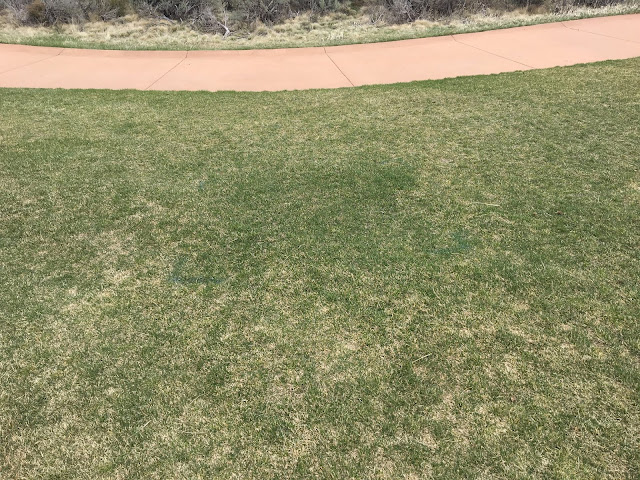
Although it wasn't a high pressure vole year, there were certainly some indications that Milorganite can be effective for vole repellency. This fall, I plan to establish some new test plots to study this repellency further. Stay tuned.

 |
| Voles active in the area, but the Milorganite plot stayed clean from any damage. |

 |
| In this test plot we had heavy vole damage on two sides, but the plot was generally clean. The arrow shows vole entry into the plot from the right side, but it appears there was repellency as very minimal damage occurred. |

 |
| Initial spring green-up noticed immediately after snowmelt with soil temperatures in the high 30's. |
Tuesday, December 12, 2017
Vole Test Plots Established
A few weeks ago, I had the opportunity to visit with both the Sonnenalp Club and Red Sky Ranch. The purpose of my visit was to establish some test plots for vole repellency/control using Milorganite organic fertilizer. Thanks to Neil Tretter, Sonnenalp Club and Michael Miner, Red Sky Ranch for being such great hosts and allowing me to perform this testing.
All test plots were 25 square feet and received a rate of one pound of nitrogen per 1000 square feet. Plots were established in areas of consistent vole damage each spring. Most areas were north facing, which will allow prolonged snow cover.
For many years I have noticed vole repellency using Milorganite. These test plots will give me a chance to replicate my past results at other facilities. Can't wait till spring to evaluate.
Special thanks to Milorganite and WinField United for their support in establishing these test plots.
All test plots were 25 square feet and received a rate of one pound of nitrogen per 1000 square feet. Plots were established in areas of consistent vole damage each spring. Most areas were north facing, which will allow prolonged snow cover.
For many years I have noticed vole repellency using Milorganite. These test plots will give me a chance to replicate my past results at other facilities. Can't wait till spring to evaluate.
Special thanks to Milorganite and WinField United for their support in establishing these test plots.
 |
| Here I am, being a mad scientist, weighing material for the test plots. |
 |
| This particular test plot at Sonnenalp had already seen some vole activity. |
 |
| Many test plots were established next to the native grass to obtain the most vole activity. |
 |
| Explaining to Sonnenalp Club superintendent, Neil Tretter about Milorganite. |
 |
| Preparing a test plot while Neil looks on. |
 |
| Always fun driving to the Red Sky facility to see how they blended the outside of their building to the development. |
 |
| Besides establishing Milorganite plots, Red Sky Ranch Director of GC Maintenance, Mike Miner and myself enjoyed a lot of Turf Talk, while on top of the world! |
 |
| Many test plots were established on north facing slopes to hold the snow cover the longest. This plot at Red Sky was shaded at 1:15pm. |
 |
| With the course closed, Red Sky was as peaceful as could be. Always felt I'm on the top of the world when visiting here. |
Thursday, November 16, 2017
Vole Management in Turf
One of the biggest issues for superintendents in the
mountain west are those little pesky voles. Voles are rodents and a relative of
the mouse. There are over 100 species of voles. The meadow vole is responsible
for the bulk of the damage in a turfgrass situation. Voles are herbivores and
the majority of their diet consists of grass stems and leaves. In the
summertime voles migrate to thick taller grassy areas for protection against
predators. However, when snowfall arrives they have protection under the snow
and this is the time they migrate to fine turf areas and cause damage. This
makes golf course turf very susceptible to wintertime damage. Voles cause turf
damage by chewing grass plants extremely low to the ground and can chew so low
they cause damage to the crown of the plant. Voles also create runways in the
winter, first by chewing the plants, then by using these to forage for
additional food each day. These runways can see extensive traffic throughout
the winter as voles forage each day on 10-15 trips.
 |
| Vole Damage in a fairway situation with no Milorganite applied. |
Most of the time voles don’t directly kill the turf plant,
although if they damage the crown extensively it is possible. The main issue
with vole damage is the slow recovery of the turf in the spring. With the
combination of cold soil temperatures and damaged turf plants, recovery can be
extremely slow. The other issue with vole damage is its effect on playability.
When a golf ball lands in one of the vole tunnels, it can nestle down and make
for a very poor lie. So until complete recovery happens playability suffers.
 |
| Vole Damage to Kentucky Bluegrass tee surrounds. The tee surface received an application of Milorganite and sand topdressing and is not touched! |
 |
| All the years we applied Milorganite to the fairways we were getting a side benefit of vole control, which we really discovered in 2014. |
 |
| Some testing I performed in some grassy hollows which every year suffers from vole damage. No Milorganite applied on the left and 0.75#N/M applied to the right. Totally clean from any damage with the Milorganite. |
Subscribe to:
Posts (Atom)