

Welcome to ONCOURSETurf! This blog is about anything and everything involved with Golf Course Management. It is the personal blog of Kevin J. Ross, CGCS - retired superintendent, Country Club of the Rockies - Vail, Colorado - Agronomic Services, ONCOURSETurf - Host of ON COURSE - TurfNetTV - General Turfgrass Management and Golf Nut. Follow Along and Enjoy! Twitter @oncourseturf
Showing posts with label snowpack. Show all posts
Showing posts with label snowpack. Show all posts
Tuesday, April 14, 2020
TurfNet TV - Latest Video is Live...
In my latest ONCOURSETurf video production for TurfNet.com I discuss a vole damage recovery technique I used while I was a superintendent in the high mountains of Colorado. This technique is different than normal thinking, but it works exceptionally well. Take a look HERE As always, thanks to my supporting sponsor www.tantoirrigation.com and thanks for watching!


Tuesday, May 28, 2019
TurfNet TV - Latest Video....
My latest video for TurfNet.com is live. In this video I discuss the importance of having either a great supply house for fuses or keeping an extra set in stock. A few days at the wrong time of year can make a big difference if your pump station goes down. Be prepared. View HERE as always, thanks to my supporting sponsor, Tanto Irrigation


Wednesday, May 23, 2018
Vole Test Plots Results
Last fall, I established some test plots using Milorganite fertilizer for vole repellency. You can read about it HERE In mid-April after snowmelt, I was able to observe the results from those test plots. This past winter season was a low pressure vole year, meaning the voles were not as active as other years. The main reason for this was the lack of snowfall and the lack of duration of what snow was recieved. Voles are primarily active under snowcover. No snow cover equals no voles. There was some snow cover however and we did see some positive results with the Milorganite use. The rate used for the test plots was 1#/N/M. Take a look at some of my findings below.


Another observation from the test plots was spring green-up. At the time of the test plot observations, soil temperatures were in the high 30's. In the photos below you can already see some spring green up occurring even with these extremely cold soil temperatures.
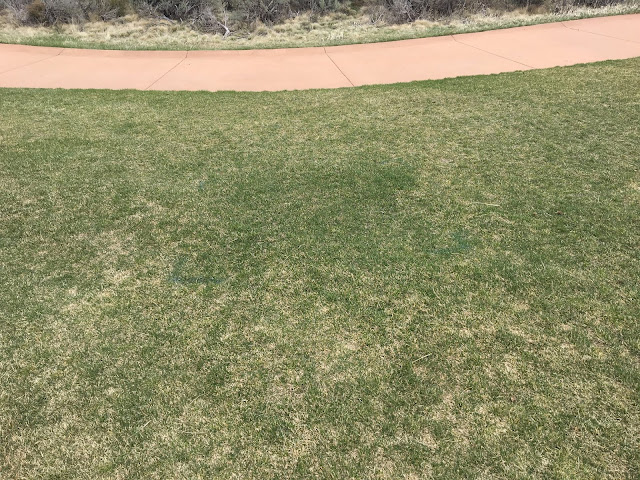
Although it wasn't a high pressure vole year, there were certainly some indications that Milorganite can be effective for vole repellency. This fall, I plan to establish some new test plots to study this repellency further. Stay tuned.

 |
| Voles active in the area, but the Milorganite plot stayed clean from any damage. |

 |
| In this test plot we had heavy vole damage on two sides, but the plot was generally clean. The arrow shows vole entry into the plot from the right side, but it appears there was repellency as very minimal damage occurred. |

 |
| Initial spring green-up noticed immediately after snowmelt with soil temperatures in the high 30's. |
Thursday, March 1, 2018
Management of Free Water on Springtime Turf..
There is no question that early spring can be a nervous time of year for golf course management teams. Finding out what the ravages of winter has done to the golf course can make or break the upcoming season. One management technique I believe is sometimes overlooked in late-winter/early-spring is the management of free water on the turf surface. With soils still frozen, water doesn't infiltrate into the soil profile, so it just sits or pools on the surface. Positive drainage is much more limited this time of year due to frost formation, snow/ice dams, even turf species and height of cut can cause issues. Through my career I have seen turf damage on multiply occasions that happens during this time of year.
Managing this free water is something everyone should be in tune with. How is it done? It's primarily about knowing the temperature and sun intensity of the day to predict the melt. If the forecast tells you it could be a melt/runoff day, then you should be prepared. You also should alert your staff that it might take working longer hours during this period. Most of this free water doesn't start accumulating until mid-afternoon. It also accumulates at once on all turf surfaces. So with these situations, it's all hands on deck, or should it be, all squeezes in the carts.

I always felt better heading home knowing we had removed all the free water possible off the turf that day. So, keep an eye towards the weather, and get those squeegees ready!
 |
| The soil around sand based greens can heave significantly more than the green surface, causing a slow surface drainage situation. This is where attention to remove water is needed. |
 |
| Here you can see how height of cut and/or turf species can pool water, even with positive surface drainage. |
Managing this free water is something everyone should be in tune with. How is it done? It's primarily about knowing the temperature and sun intensity of the day to predict the melt. If the forecast tells you it could be a melt/runoff day, then you should be prepared. You also should alert your staff that it might take working longer hours during this period. Most of this free water doesn't start accumulating until mid-afternoon. It also accumulates at once on all turf surfaces. So with these situations, it's all hands on deck, or should it be, all squeezes in the carts.
 |
| Another example of how height of cut can slow water movement. |
 |
| The use of squeegees to remove the meltwater off the turf surface is the best option. |

I always felt better heading home knowing we had removed all the free water possible off the turf that day. So, keep an eye towards the weather, and get those squeegees ready!
Wednesday, January 17, 2018
Winter? Where?
The calendar says winter, but if you look outside in many parts of Colorado it's not! In my 25 years of living in the Vail Valley, this is the driest winter yet. As of January 15th the SWE (Snow Water Equivalent) is at 47% of normal for Vail Mountain. Many golf courses in Colorado, especially the front range and western slope continue to winter water to prevent desiccation. Although there is a lot of winter left, it's certainly starting to sound the alarms concerning water availability and drought for this summer.
 |
| Most recent SWE graph. |
 |
| Walking Eagle Ranch Golf Club on January 15th, it didn't seem like winter. |
 |
| This is what I usually see on Eagle Ranch GC this time of year. The groomer hasn't left the shop this season! |
 |
| Haven't even dusted off the Nordic skate ski's this season. Normally I have about 30 days of skating in at this time. |
Thursday, December 21, 2017
Snow Water Equivilency
I know it's early in the winter season, but let's just say things are off to a very bad start. Snow water equivalency for Vail Mountain is at 21% of normal. I don't think I have seen it this low ever, for this time of year? Fortunately, it's still early and things can change quickly. Take a look at the latest graph.


Tuesday, December 12, 2017
Vole Test Plots Established
A few weeks ago, I had the opportunity to visit with both the Sonnenalp Club and Red Sky Ranch. The purpose of my visit was to establish some test plots for vole repellency/control using Milorganite organic fertilizer. Thanks to Neil Tretter, Sonnenalp Club and Michael Miner, Red Sky Ranch for being such great hosts and allowing me to perform this testing.
All test plots were 25 square feet and received a rate of one pound of nitrogen per 1000 square feet. Plots were established in areas of consistent vole damage each spring. Most areas were north facing, which will allow prolonged snow cover.
For many years I have noticed vole repellency using Milorganite. These test plots will give me a chance to replicate my past results at other facilities. Can't wait till spring to evaluate.
Special thanks to Milorganite and WinField United for their support in establishing these test plots.
All test plots were 25 square feet and received a rate of one pound of nitrogen per 1000 square feet. Plots were established in areas of consistent vole damage each spring. Most areas were north facing, which will allow prolonged snow cover.
For many years I have noticed vole repellency using Milorganite. These test plots will give me a chance to replicate my past results at other facilities. Can't wait till spring to evaluate.
Special thanks to Milorganite and WinField United for their support in establishing these test plots.
 |
| Here I am, being a mad scientist, weighing material for the test plots. |
 |
| This particular test plot at Sonnenalp had already seen some vole activity. |
 |
| Many test plots were established next to the native grass to obtain the most vole activity. |
 |
| Explaining to Sonnenalp Club superintendent, Neil Tretter about Milorganite. |
 |
| Preparing a test plot while Neil looks on. |
 |
| Always fun driving to the Red Sky facility to see how they blended the outside of their building to the development. |
 |
| Besides establishing Milorganite plots, Red Sky Ranch Director of GC Maintenance, Mike Miner and myself enjoyed a lot of Turf Talk, while on top of the world! |
 |
| Many test plots were established on north facing slopes to hold the snow cover the longest. This plot at Red Sky was shaded at 1:15pm. |
 |
| With the course closed, Red Sky was as peaceful as could be. Always felt I'm on the top of the world when visiting here. |
Friday, August 11, 2017
So you think its been Raining??
This is some of the most interesting data I have seen recently concerning rainfall in Colorado this summer. Everyone seems to think its been raining everyday, when in fact that's not the case throughout the entire state. Take a look at those red numbers, pretty amazing! Eagle to Steamboat is just slightly over 1/3 of the summer average, where the southeastern portion of the state is well above average. This just goes to show how localized the weather patterns can be in Colorado. Hopefully, some of those red and yellow areas can catch up over the next couple months.


Monday, May 22, 2017
Snowpack.....You Just Never Know?
The latest snow-water equivalency graphs show that you just never know in Colorado. Vail Mountain SWE is down to just 15% of normal, while just on the other side of the hill, Copper Mountain is sitting at 116% of normal. This is vey unusual considering the proximity of these two areas. Hopefully the recent snowfall will help everyone add to these figures, before more runoff resumes.


Friday, April 21, 2017
Snow-Water Equivalency Below Normal...
One thing is certain about Colorado, weather conditions can change rapidly. Sitting in my new home office a few months ago looking out the window and watching it snow almost daily made me think of big snowpack and plenty of water. Suddenly, a few months later, how times have changed! A few months ago snow-water equivalentcy hovered around 150%, yesterday's reading came in at 59%. Ouch, that is some dip. Let's hope some spring moisture comes along.
 |
| The rapid rise in yellow, followed by the sharp decline in green. |
Sunday, April 9, 2017
Elk Damage this Season...
This spring I have been asked many times why there is so much Elk damage to trees in many housing areas. I believe it mostly occurred during late January to early February when snowfall hit hard and fast. This left very little food in the higher elevations and Elk herds migrated quickly to lower elevations for food, which brought them in contact with housing developments. One thing is certain when it comes to an Elk herd migrating through your property, nothing is safe! When these animal are hungry and looking for food, watch out.
 |
| Common sight this year in my backyard. |
 |
| Aspen trees, as usual, suffer the worst of the damage. |
 |
| Nothing is safe. Here the ends of this Spruce tree are chewed above the netting, which extends to 6 feet high. Elk have a 6'-7' reach, which makes protecting trees very difficult. |
Saturday, March 25, 2017
Snow-Water Equivalency takes a DIVE!
One thing is certain about Colorado.....you just never know about the weather. After a 6 week stretch of intense snowfall from late December to early February, things have change. A snow drought over the past 6 weeks has cause the snow-water equivalency to plummet! Although at 100% presently, the long term forecast shows very little moisture headed our way. Take a look at the latest graph and notice the drop.


Saturday, January 28, 2017
Colorado Snowpack....
Presently the State of Colorado is relishing in some tremendous snowpack. This is nothing but great news from an environmental standpoint. Water for the western US is based largely on snowpack, so this could be the year that we finally replenish all those reservoirs. It's still early to celebrate, but you can't help but feel a little giddy about the map below...


Subscribe to:
Posts (Atom)