

Welcome to ONCOURSETurf! This blog is about anything and everything involved with Golf Course Management. It is the personal blog of Kevin J. Ross, CGCS - retired superintendent, Country Club of the Rockies - Vail, Colorado - Agronomic Services, ONCOURSETurf - Host of ON COURSE - TurfNetTV - General Turfgrass Management and Golf Nut. Follow Along and Enjoy! Twitter @oncourseturf
Showing posts with label organic matter. Show all posts
Showing posts with label organic matter. Show all posts
Sunday, February 23, 2020
Great Podcast...

Sunday, February 2, 2020
TurfNet TV - Latest Video is Live...
In my latest ONCOURSETurf video production for TurfNet.com I discuss an aerification technique I developed for sand based system greens. This technique helps eliminate the surface softness, which occurs during the aerification process to the green surface. To view this video, please click HERE As always, thanks to my supporting sponsor www.tantoirrigation.com and thanks for watching!


Monday, December 17, 2018
TurfNetTV - Latest Video is Live....
My latest ON COURSE video for TurfNet.com is live. In this video I chat with Matt Gourlay, CGCS - superintendent at Colbert Hills Golf Course in Manhattan, KS. We discuss his "More is Less" philosphy about turfgrass management. Matt also gives us some insight about what it meant to be named TurfNet Superintendent of the Year back in 2015. Please click HERE to view. As always, thanks to my supporting sponsor Tanto Irrigation


Sunday, October 28, 2018
Dormant Fertilization
Dormant fertilization is one turfgrass management practice that I believe is vital for a successful upcoming season. I have been a big fan of dormant fertilization throughout my entire career. My definition of dormant fertilization is: fertilizing when temperatures have dropped sufficiently to stop top growth - basically, when mowing has ceased. At this time, however, root growth can still be active.
What fertilizer is best for dormant fertilization? There are many choices, but for 40+ years of golf course management career I have used the natural organic Milorganite. Milorganite was my go-to fertilizer for all dormant applications. Each fall when top growth stopped, we fertilized the entire golf course with Milorganite.
 |
| Alway a great time of year when the dormant Milorganite application goes out! |
 |
| Always a smile on my face when spreading Milorganite. |
Greens, tees, fairways, and rough all received between 0.75#N/M-1.25#N/M. Even today, as a consulting agronomist, it is the single most important fertilization practice I recommend and discuss with clients. I do get questions on why Milorganite. So, let’s discuss the reasons why it’s such a great fertilizer and why it’s particularly great for a dormant application.
First, Milorganite has been in business for over 90 years. That is some kind of staying power. Some of the reason for that is the consistency with the manufacturing of this product. In my 40+ years of using this material, I have never opened a bag that had an issue - truly remarkable. To have a better understanding of the production of Milorganite, check out this great video link, HERE.
 |
| The consistency in the manufacturing of this product is truly amazing! |
Second, Milorganite may be the most researched fertilizer in the world. So, why is it such a great dormant fertilizer choice? First, as an organic, it is very stable and leaching concerns are non-existent during fall/winter. So, from that aspect, it is very environmentally safe and gives great piece of mind. From a turfgrass plant use, the real key to dormant Milorganite is all about nitrogen mineralization. Consistent research results show that microorganisms responsible for the mineralization of the organic nitrogen in Milorganite remain active even in frozen soils. The percent of nitrogen mineralization throughout the winter period has been shown to be in the 15% range. This has been documented multiple times through university research.
 |
| Possibly the most researched fertilizer ever! |
So for example, if you apply 1#N/M to your fairways as a dormant application, there will be 0.15N/M available immediately to the plant after snowmelt. Nitrogen availability, along with the iron content, will produce tremendous spring green-up without any flush of growth.
 |
| Early spring fairway green-up. |
 |
| Early green surface green-up. |
This nitrogen availability will easily be 2-3 weeks ahead of any spring-applied fertilizer. The remaining nitrogen fraction will be released during the growing season to help with the peaks and valleys of a conventional fertilizer release curve. So, it’s that time of year to set yourself up for next season – using Milorganite as dormant fertilization will certainly be a big help! Milorganite is a fabulous choice for dormant fertilization.
Thursday, September 20, 2018
Greens Construction Amendments......
When it comes to USGA greens
construction, the addition of rootzone organic amendments can certainly make a
major difference during the grow-in/establishment phase. Many times, superintendents are
under tremendous pressure to establish new greens as fast as possible and get
them ready for play. The use of amendments is a great way to help accomplish
this. One organic amendment, Milorganite, has been one of the most used and
successful amendments for greens construction for many years. I’ve personally
used Milorganite as an amendment in greens construction throughout my career
and have seen excellent results. I would personally not perform any greens
construction and grow-in without the supplemental use of Milorganite.
 |
| Adding an organic amendment such as Milorganite during greens construction can enhance establishment dramatically. |
Research was conducted at the
University of Wisconsin-Madison using various organic fertilizer amendments
showed some very interesting results. All plots treated with amendments showed
more rapid grow-in than the control plot. The study also found that adding
additional organic materials to the rootzone mix increased firmness and
stability, improved water retention and water infiltration rates, enhanced
color, increased rooting depth and reduced phosphorous deficiency symptoms.
As you can see in the graph below, Milorganite
amended plots rated numerically higher or, at minimum, equal to the highest
treatment, in all categories. Adding Milorganite to the original off-site mix
or as an on-site supplement increased the establishment and performance of the new greens construction plots. |
| This photo shows the incredible rooting and establishment of a USGA green I constructed a few years ago with the use of Milorganite. |

As fall golf course renovation hits full stride, consider adding an organic amendment such as Milorganite to your rootzone mix for superior grow-in and establishment of USGA greens construction.
Wednesday, May 23, 2018
Vole Test Plots Results
Last fall, I established some test plots using Milorganite fertilizer for vole repellency. You can read about it HERE In mid-April after snowmelt, I was able to observe the results from those test plots. This past winter season was a low pressure vole year, meaning the voles were not as active as other years. The main reason for this was the lack of snowfall and the lack of duration of what snow was recieved. Voles are primarily active under snowcover. No snow cover equals no voles. There was some snow cover however and we did see some positive results with the Milorganite use. The rate used for the test plots was 1#/N/M. Take a look at some of my findings below.


Another observation from the test plots was spring green-up. At the time of the test plot observations, soil temperatures were in the high 30's. In the photos below you can already see some spring green up occurring even with these extremely cold soil temperatures.
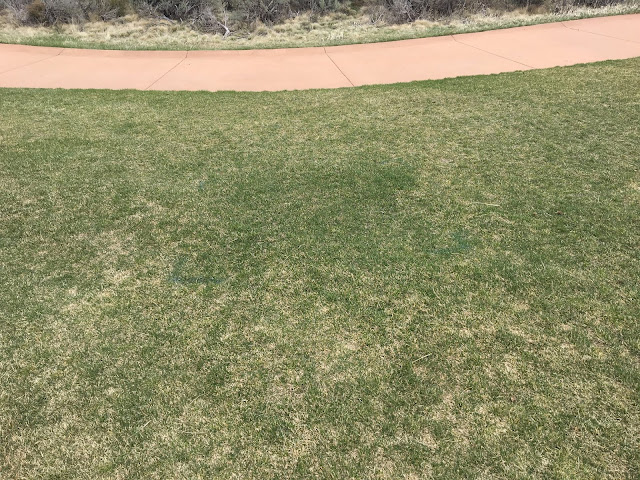
Although it wasn't a high pressure vole year, there were certainly some indications that Milorganite can be effective for vole repellency. This fall, I plan to establish some new test plots to study this repellency further. Stay tuned.

 |
| Voles active in the area, but the Milorganite plot stayed clean from any damage. |

 |
| In this test plot we had heavy vole damage on two sides, but the plot was generally clean. The arrow shows vole entry into the plot from the right side, but it appears there was repellency as very minimal damage occurred. |

 |
| Initial spring green-up noticed immediately after snowmelt with soil temperatures in the high 30's. |
Thursday, June 8, 2017
Great Podcast with Dr. Frank Rossi...
This podcast from TurfNet.com with Dr. Frank Rossi is a must listen. Frank chats with my good friend Dan Dinelli, Superintendent at North Shore Country Club and Dr. Roch Gaussoin, University of Nebraska. Dan has been performing his own research for greens construction and performance for almost 20 years at North Shore. His findings and opinions are truly fascinating. If you haven't listened to this podcast and you are in the golf industry, an agronomist, or a golfer, what are you waiting for? Click HERE


Subscribe to:
Posts (Atom)